AMC 8 · 2022 · #25
Grade 7 probabilitycountingProblem
A cricket randomly hops between 4 leaves, on each turn hopping to one of the other 3 leaves with equal probability. After 4 hops what is the probability that the cricket has returned to the leaf where it started?
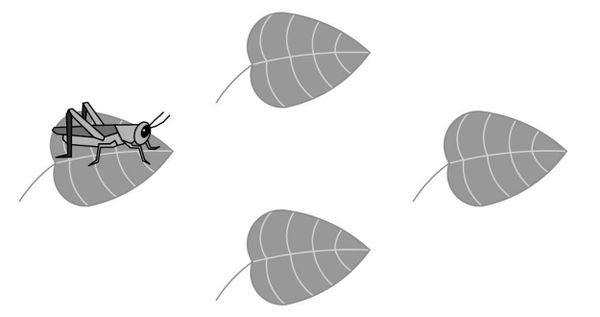
Pick an answer.
AMC 8 2022 problem © Mathematical Association of America (MAA AMC). Reproduced for educational use.
Try it yourself first — the explanation is most useful after you’ve attempted it.
Toolkit + CCSS Solution
Understand
Restated: A cricket sits on one of $4$ leaves. Each turn it jumps to one of the other $3$ leaves, chosen uniformly at random. After exactly $4$ jumps, what is the probability that it is back on the leaf it started from?
Givens: There are $4$ leaves; call the starting leaf $A$ and the others $B$, $C$, $D$; Each jump goes to one of the $3$ other leaves with equal probability $\tfrac{1}{3}$; The cricket makes exactly $4$ jumps; Answer choices: (A) $\tfrac{2}{9}$, (B) $\tfrac{19}{80}$, (C) $\tfrac{20}{81}$, (D) $\tfrac{1}{4}$, (E) $\tfrac{7}{27}$
Unknowns: The probability $p_4$ that the cricket is on leaf $A$ after $4$ jumps
Understand
Restated: A cricket sits on one of $4$ leaves. Each turn it jumps to one of the other $3$ leaves, chosen uniformly at random. After exactly $4$ jumps, what is the probability that it is back on the leaf it started from?
Givens: There are $4$ leaves; call the starting leaf $A$ and the others $B$, $C$, $D$; Each jump goes to one of the $3$ other leaves with equal probability $\tfrac{1}{3}$; The cricket makes exactly $4$ jumps; Answer choices: (A) $\tfrac{2}{9}$, (B) $\tfrac{19}{80}$, (C) $\tfrac{20}{81}$, (D) $\tfrac{1}{4}$, (E) $\tfrac{7}{27}$
Plan
Primary tool: #9 Solve an Easier Related Problem
Secondary: #5 Look for a Pattern, #1 Draw a Diagram
Going from $4$ jumps to the answer in one shot is hard, but going from $n$ jumps to $n+1$ jumps is easy — that is exactly Tool #9 (Solve an Easier Related Problem) applied to the time variable. Use Tool #1 (Draw a Diagram) to picture the $4$ leaves with edges between every pair ($K_4$); the picture makes the symmetry obvious — leaves $B$, $C$, $D$ are interchangeable, so they always share the same probability $q_n$ of holding the cricket after $n$ jumps. That symmetry collapses $4$ unknowns down to just two ($p_n$ for leaf $A$ and $q_n$ for any other leaf), and Tool #5 (Look for a Pattern) then turns the problem into a tiny one-step recursion that we run for $n=1,2,3,4$.
Execute — Answer: E
7.SP.C.7 Step 1 - Draw the setup.
- Put leaves $A$, $B$, $C$, $D$ at the four corners of a square (or tetrahedron) and connect every pair with a line — that is the graph $K_4$.
- From any leaf the cricket has exactly $3$ outgoing edges, each used with probability $\tfrac{1}{3}$.
- Because $B$, $C$, $D$ are connected to $A$ and to each other in the same way, they are symmetric.
💡 Drawing $K_4$ shows that all non-$A$ leaves play the same role, so we only need two numbers to track the cricket: "on $A$" or "on one of the others."
7.SP.C.7 Step 2 - Define the two state probabilities after $n$ jumps: $p_n =$ probability of being on $A$, and $q_n =$ probability of being on any one specific non-$A$ leaf.
- By symmetry the three non-$A$ probabilities are equal, so the total probability adds to $p_n + 3 q_n = 1$.
💡 Collapsing the four leaves into the two cases "on $A$" / "on a typical other" is the Tool #9 move: the easier related problem has only $2$ states instead of $4$.
5.NF.B.4 Step 3 - Write the one-step recurrence.
- To land on $A$ after the next jump, the cricket must currently be on one of $B$, $C$, $D$ (total probability $3 q_n$) and then choose $A$ (probability $\tfrac{1}{3}$), giving $p_{n+1} = 3 q_n \cdot \tfrac{1}{3} = q_n$.
- To land on a specific non-$A$ leaf, say $B$, either you were on $A$ and jumped to $B$ (chance $p_n \cdot \tfrac{1}{3}$) or you were on $C$ or $D$ and jumped to $B$ (chance $2 q_n \cdot \tfrac{1}{3}$).
💡 Each rule just adds up "chance of being there" $\times$ "chance of jumping here" — Grade 5 fraction-times-fraction reasoning.
5.NF.A.1 Step 4 - Run the recurrence for $n = 1, 2, 3, 4$, starting from $p_0 = 1$, $q_0 = 0$.
- After each step, check that $p_n + 3 q_n = 1$.
💡 Adding fractions like $\tfrac{1}{3} + \tfrac{4}{9} = \tfrac{7}{9}$ is exactly the Grade 5 "unlike denominators" skill repeated four times.
7.SP.C.8 Step 5 - Read off the answer.
- After $4$ jumps the probability the cricket is back on its starting leaf $A$ is $p_4 = \tfrac{7}{27}$, which matches choice (E).
💡 Compound-event probability over $4$ jumps lands cleanly on a fraction in the answer list — Grade 7 probability of multi-step events.
7.SP.C.7 Draw the setup. Put leaves $A$, $B$, $C$, $D$ at the four corners of a square (o 7.SP.C.7 Define the two state probabilities after $n$ jumps: $p_n =$ probability of being 5.NF.B.4 Write the one-step recurrence. To land on $A$ after the next jump, the cricket m 5.NF.A.1 Run the recurrence for $n = 1, 2, 3, 4$, starting from $p_0 = 1$, $q_0 = 0$. Aft 7.SP.C.8 Read off the answer. After $4$ jumps the probability the cricket is back on its Review
Reasonableness: Sanity check 1: $p_n + 3 q_n = 1$ at every step (e.g. $\tfrac{7}{27} + 3 \cdot \tfrac{20}{81} = \tfrac{21}{81} + \tfrac{60}{81} = 1$). Sanity check 2: if jumps were random over all $4$ leaves (including staying), the long-run probability of being on $A$ would be $\tfrac{1}{4} = 0.25$. Our answer $\tfrac{7}{27} \approx 0.259$ is just slightly above $\tfrac{1}{4}$, which makes sense because $4$ is an even number of jumps and the cricket is forced to move each turn, very slightly biasing it back toward $A$. Choices (A) $\tfrac{2}{9} \approx 0.222$ and (D) $\tfrac{1}{4} = 0.25$ are too low; (B) $\tfrac{19}{80}$ has the wrong denominator family (should involve $3^n$). Only (E) fits.
Alternative: Tool #2 (Systematic List) with Tool #7 (Identify Subproblems): the total number of $4$-jump sequences is $3^4 = 81$. List the successful ones by splitting on whether jump $2$ returns to $A$. Case 1 ($A \to X \to A \to Y \to A$): $3 \cdot 3 = 9$ sequences. Case 2 ($A \to X \to Y \to Z \to A$ with $Y \ne A$): $3 \cdot 2 \cdot 2 = 12$ sequences ($3$ choices for $X$, $2$ choices for $Y \ne A$, and $Z$ must be a non-$A$ neighbor of $A$ different from $Y$, which gives $2$ choices). Total successful $= 9 + 12 = 21$, so probability $= \tfrac{21}{81} = \tfrac{7}{27}$.
CCSS standards used (min grade 7)
5.NF.A.1Add and subtract fractions with unlike denominators (Computing recurrence sums like $\tfrac{1}{3} + \tfrac{4}{9} = \tfrac{3}{9} + \tfrac{4}{9} = \tfrac{7}{9}$ at each step.)5.NF.B.4Apply and extend understanding of multiplication to multiply a fraction by a fraction (Multiplying "chance of being on a leaf" by "chance of jumping to a target" — e.g. $q_n \cdot \tfrac{1}{3}$ — to build $p_{n+1}$ and $q_{n+1}$.)7.SP.C.7Develop probability models and use them to find probabilities of events (Setting up the symmetric two-state probability model ($p_n$ for leaf $A$, $q_n$ for any other leaf) for the cricket on $K_4$.)7.SP.C.8Find probabilities of compound events using organized lists, tables, and simulation (Combining $4$ jumps into a single compound-event probability $p_4 = \tfrac{7}{27}$.)
⭐ This AMC 8 problem only needs Grade 7 compound-event probability — "chance of step 1 times chance of step 2 times..." — that you already know!
⭐ This AMC 8 problem only needs Grade 7 compound-event probability — "chance of step 1 times chance of step 2 times..." — that you already know!
More like this
Same archetype — closest grade level first.