compound-area-decomposition
"도형을 조각내면 보이는 답"
A composite planar region is computed as a sum or difference of simpler shapes (rectangles, squares, circles, annular rings, triangles). The work is in choosing the decomposition; each piece uses a single elementary area formula.
어려운 도형 문제의 단골 — 큰 도형을 단순한 모양으로 쪼개기.
풀이 전략
- Change shape_family from squares to circles to convert area answers into multiples of pi
- Add a layer (e.g. 5 nested squares) to scale difficulty without changing strategy
- Shift dimension_set so both the total and difference areas remain in the answer-choice range
세부 유형 분포 (5)
한 줄을 클릭하면 그 안의 문제를 볼 수 있어요.
- nested-frame-difference 16% (17)
Two or more concentric or corner-aligned shapes of the same family (squares, circles, triangles) are stacked in layers; the target area is the alternating sum of outer minus inner, producing rings, frames, or banded annular regions.
- rectangle-frame-border 14% (15)
A rectilinear shape (rectangle, L-shape, notched polygon, or 3D box) is described as a large outer rectangle minus a smaller inner rectangle; all boundary pieces are axis-aligned, and the target region is the uniform or non-uniform border that remains.
- polygon-triangulation 48% (51)
A polygon (trapezoid, quadrilateral, hexagon, star, or irregular lattice shape) is split into triangles and/or rectangles by drawing diagonals or altitudes; each resulting piece uses only a basic triangle or rectangle area formula, with no circular pieces involved.
no figureamc10-2019B-16 amc10-2019B-8
 amc10-2020A-12no figureamc10-2020A-20
 amc10-2020B-21
 amc10-2021A-12no figureamc10-2021A-13
 amc10-2021A-17
 amc10-2021A-21
 amc10-2021B-20
 amc10-2022B-16
 amc10-2022B-2
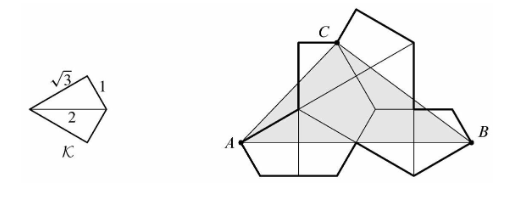 amc10-2024A-22no figureamc10-2024B-10
 amc10-2024B-11
 amc8-1999-14
 amc8-2000-25
 amc8-2001-9
 amc8-2002-16
 amc8-2002-20
 amc8-2003-21
 amc8-2004-24
 amc8-2005-19
 amc8-2007-12
 amc8-2007-23
 amc8-2007-8
 amc8-2008-23
 amc8-2008-6
 amc8-2010-17no figureamc8-2011-16
 amc8-2011-20
 amc8-2011-7no figureamc8-2012-23
 amc8-2013-24
 amc8-2015-2
 amc8-2015-21
 amc8-2015-25no figureamc8-2015-6
 amc8-2016-2
 amc8-2016-22
 amc8-2017-16
 amc8-2017-18
 amc8-2017-22
 amc8-2018-20
 amc8-2018-22
 amc8-2018-24
 amc8-2018-4
 amc8-2019-24
 amc8-2019-4
 amc8-2023-24
 amc8-2025-1
 - circle-polygon-hybrid 20% (21)
The region of interest combines at least one circular piece (full circle, annulus, sector, semicircle, or circular arc) with at least one polygonal piece; computing the total area requires both the circle area formula involving pi and a polygon area formula, combined by addition or subtraction.
 amc10-2019B-20no figureamc10-2020A-16
 amc10-2020B-10
 amc10-2020B-14no figureamc10-2020B-20no figureamc10-2021A-19
 amc10-2021B-23no figureamc10-2022A-15no figureamc10-2024A-14no figureamc10-2024B-14
 amc10-2024B-21
 amc8-2000-19
 amc8-2003-22
 amc8-2005-23
 amc8-2008-21
 amc8-2010-18
 amc8-2012-24no figureamc8-2013-20
 amc8-2014-20
 amc8-2016-25
 amc8-2017-25
 - overlapping-translates 3% (3)
Two or more copies of the same shape (congruent triangles, squares, or circles) are placed so their interiors intersect; the union area is computed via inclusion-exclusion by adding individual areas and subtracting the doubly-counted overlap region.


더 보기 (연도 추세, 도구 fingerprint, 학년 분포, 전체 문제)
도구 fingerprint (1–17)
학년 분포
- Gr 3 6
- Gr 4 3
- Gr 5 2
- Gr 6 23
- Gr 7 19
- Gr 8 53